
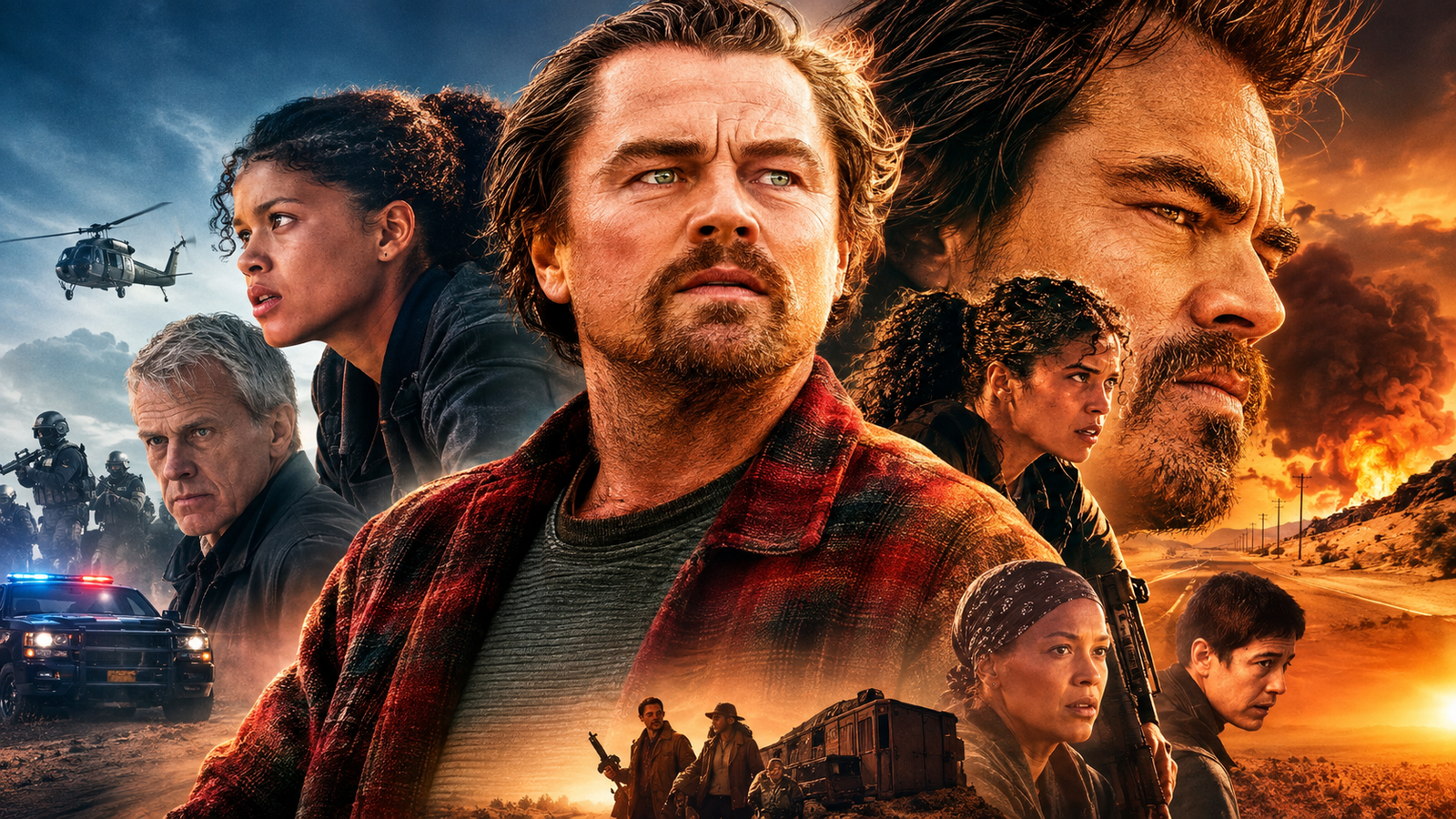
You searched for the one battle after another movie for a reason. Maybe you just watched it. Maybe you are about to. Maybe that final car chase is still stuck in your head days later. All three reactions are common right now.
Paul Thomas Anderson built a sprawling, funny, and surprisingly emotional epic here. It has become one of the most talked about films of the decade, and it earns that attention.
This guide gives you everything in one place. You will find a spoiler free overview, a full plot breakdown, a clear explanation of that layered ending, and current streaming information. If you just need someone to explain what happened to Lockjaw, keep reading.
Quick Overview: What Is One Battle After Another About
One Battle After Another is a 2025 action comedy thriller. Paul Thomas Anderson wrote, directed, and produced it. Leonardo DiCaprio, Sean Penn, Benicio del Toro, Regina Hall, Teyana Taylor, and newcomer Chase Infiniti lead the cast.
At its core, this is a father daughter story wrapped inside a chase movie. Bob is a washed up former revolutionary living off the grid. He has to protect his teenage daughter Willa when an old enemy resurfaces after sixteen years. The film delivers two and a half hours of tension, sudden bursts of humor, and one of the most talked about car chase sequences in recent memory.
The film runs 162 minutes. Anderson shot most of it on VistaVision, a high resolution widescreen film format from the 1950s that filmmakers had barely touched since. That choice signals something clear: Anderson wanted the film to feel both classic and urgent at once.
Cast and Characters
Knowing who is who makes the plot much easier to follow. Several characters go by more than one name throughout the story, so this section will help.
- Leonardo DiCaprio plays Bob Ferguson, formerly known as Pat Calhoun. He worked as an explosives expert for a radical group and has spent sixteen years hiding as a paranoid, overprotective single father.
- Sean Penn plays Colonel Steven J. Lockjaw, a corrupt and racist military officer. His obsession with Bob’s family drives the entire plot.
- Benicio del Toro plays Sergio St. Carlos, Willa’s karate instructor and a respected community leader. He becomes an unexpected ally.
- Teyana Taylor plays Perfidia Beverly Hills, Bob’s former lover and Willa’s mother. Her choices sixteen years earlier set the whole story in motion.
- Chase Infiniti makes her film debut as Willa Ferguson, Bob’s fiercely independent teenage daughter.
- Regina Hall plays Deandra, a former member of the revolutionary group who resurfaces to help when things fall apart.
Wood Harris, Alana Haim, and Tony Goldwyn round out a supporting cast that adds real texture to this world.
The Story Behind the Story: Vineland and Paul Thomas Anderson’s Vision
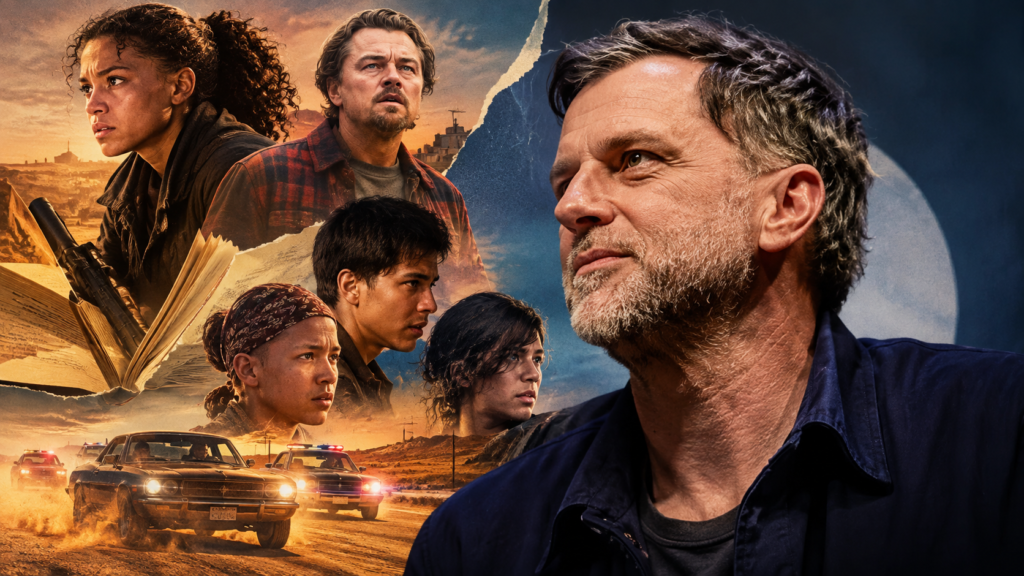
Thomas Pynchon’s 1990 novel Vineland loosely inspired One Battle After Another. The book follows former countercultural radicals as they grapple with what became of their ideals during the Reagan era. Anderson wanted to adapt the novel since the early 2000s, but he kept setting it aside. He worried his love for the source material would get in the way of shaping his own story.
Instead, he combined elements of Vineland with two separate ideas he had been developing. One was a desert set action movie built around a car chase. The other centered on a female revolutionary. The result shares Vineland’s DNA, especially its father daughter relationship and its interest in aging radicals, without becoming a direct retelling.
This distinction matters if you expect a faithful literary adaptation. You will not get one here. Think of the film as a spiritual cousin to the novel rather than a page to screen translation.
Full Plot Summary (Spoilers Ahead)
Skip ahead to the streaming section if you have not seen the film and want to avoid spoilers. Everyone else, here is what actually happens.
Sixteen Years Earlier
Pat Calhoun and Perfidia Beverly Hills belong to the French 75, a militant revolutionary group. During a raid to free detained immigrants from a facility, Perfidia humiliates the commanding officer, Steven Lockjaw. He becomes fixated on her, and the two begin a dangerous affair even while he hunts her group.
Perfidia gets pregnant and gives birth to a daughter named Charlene. The pressure of motherhood and her own unresolved history weigh on her, and she eventually abandons her family to continue her revolutionary work. Police arrest her after a botched robbery. She strikes a deal with Lockjaw and trades information on her former comrades for her freedom. That betrayal costs several French 75 members their lives.
Pat and Charlene receive new identities and disappear into hiding as Bob and Willa Ferguson.
Sixteen Years Later
Bob now lives as a paranoid, pot smoking single father in the sanctuary city of Baktan Cross. Willa has grown into a self reliant teenager. She has no idea her mother is alive or that her father’s past is catching up to both of them.
Lockjaw has become a powerful colonel, and a white supremacist secret society called the Christmas Adventurers Club has taken notice of him. Before they will accept him, he needs to erase any trace of his relationship with a Black woman. That requirement makes Willa a target.
Federal forces raid Baktan Cross under the cover of an immigration operation. Willa escapes to a convent connected to the remnants of the French 75. Officers arrest Bob during the chaos but fail to recognize him. Lockjaw tracks Willa’s phone and closes in, and what he discovers next changes everything.
The DNA Reveal
Lockjaw orders a DNA test and confirms Willa is his biological daughter, not Bob’s. That revelation sets multiple parties into motion at once. Bob, desperate to reach her, escapes custody with Sergio’s help and races toward the convent. Members of the Christmas Adventurers Club fear exposure, so they send an assassin after both Lockjaw and Willa.
What follows is the film’s centerpiece: a sprawling, disorienting car chase across rolling desert hills. Anderson shoots it in a way that deliberately makes it hard to tell who is chasing whom.
One Battle After Another Ending Explained
This section spoils the final act completely. Proceed only if you have already watched the film or do not mind knowing how it ends.
Three separate pursuits converge in the climax. Tim Smith, a member of the Christmas Adventurers Club, tracks down Lockjaw and shoots him in the face during a car chase. Bob later finds Lockjaw’s crash site while still searching for Willa. He does not realize right away that his longtime enemy is already dead.
Meanwhile, the bounty hunter Avanti has orders to deliver Willa to a far right militia. He has a last minute change of heart instead. He frees her, then dies in a shootout defending that choice. Willa escapes in his car, but Tim picks up her trail and pursues her directly.
The final confrontation shows off the film’s craftsmanship. Willa is alone and being hunted on an isolated stretch of road. She lures Tim into a blind summit crash. He survives the crash but fails to recite the French 75’s old countersign, a coded phrase drawn from Gil Scott Heron’s poem The Revolution Will Not Be Televised. She shoots and kills him. This brutal, decisive moment marks her shift from protected child to someone who can protect herself.
Bob finally catches up to Willa, and they embrace. Some time later, a badly scarred Lockjaw appears to gain acceptance into the Christmas Adventurers Club, only to be fatally gassed and cremated almost immediately afterward. It is a grim final joke at the expense of a man who spent the whole film chasing acceptance from people who never valued him as more than useful.
In the closing moments, Bob gives Willa a letter from Perfidia. She apologizes for her past choices and promises to reunite with her family someday. Bob gives Willa his blessing as she leaves to attend a protest in Oakland, and she effectively picks up the torch her parents once carried.
What the Ending Actually Means
The ending resists a tidy resolution on purpose. Lockjaw’s death feels almost anticlimactic, and Anderson denies him the dramatic confrontation the story seems to build toward. That choice reinforces one of the film’s central ideas: institutions and ideologies chew people up regardless of which side they think they are on.
Willa’s arc closes on cautious hope rather than triumph. She survives, she asserts herself, and she chooses to continue the fight her parents started. But the film never pretends that fight is finished. The final shot of her walking toward a protest echoes the title itself. There will always be one battle after another, generation after generation.
Perfidia’s letter leaves the door open for her story to continue. That choice lines up with public comments from Teyana Taylor about wanting to explore a potential companion piece or sequel centered on her character. Nothing has been confirmed, but the ending clearly leaves room for that possibility.
Why the Film Resonates: Themes and Political Context
Much of the conversation around One Battle After Another centers on its political charge. The film never names any real agency directly, but it draws a clear line to modern immigration enforcement. Several critics have pointed out how closely its fictional raids echo real world events involving federal immigration operations.
The film also explores generational trauma. It examines the difficulty of raising a child while carrying unresolved guilt, and it asks what happens to radical ideals once the people who held them grow older and more tired. Bob is not a hero in the traditional sense. He spends much of the film ineffective, high, and reactive rather than proactive, which makes his eventual moment of clarity land harder.
Critics remain split on how the film handles Perfidia’s character. Some argue her portrayal leans too heavily on her sexuality. Others, including Teyana Taylor herself, push back on that reading and call it a misunderstanding of a woman shown in genuine crisis. That debate has kept the film in cultural conversation for months after release.
The Look and Sound of the Film
Cinematographer Michael Bauman shot roughly 75 to 80 percent of the film on VistaVision. This format produces a noticeably richer, larger negative than standard 35mm. Anderson wanted the visual roughness of 1970s films like The French Connection, and the production team reportedly screened a physical print of that film throughout the shoot to stay aligned tonally.
Longtime Anderson collaborator Jonny Greenwood composed the score and recorded it with the London Contemporary Orchestra. The music swings between tense and playful in ways that mirror the film’s own genre blending. It moves from thriller to comedy and back without ever feeling jarring.
Critical Reception and Awards

One Battle After Another stands as one of the most acclaimed films of its release year. It holds a 94 percent approval rating on Rotten Tomatoes from over 400 critics, and Metacritic gave it a 95 out of 100 score, which the site labels universal acclaim.
The film won six Oscars from thirteen nominations at the Academy Awards, including Best Picture, Best Director for Anderson, Best Supporting Actor for Sean Penn, and Best Adapted Screenplay. It also picked up major wins at the BAFTAs, Golden Globes, and Critics Choice Awards, and it topped numerous critics’ year end lists.
The film underperformed financially relative to its cost despite the acclaim. It grossed 213 million dollars worldwide against a production budget reported between 130 and 175 million dollars, plus a substantial marketing spend. Even so, it remains Paul Thomas Anderson’s highest grossing film to date.
Where to Watch One Battle After Another
Here are your main options if you are ready to watch or rewatch the film.
- Streaming: HBO Max carries the film, and it became one of the platform’s most streamed titles shortly after release.
- Digital rental or purchase: Major digital storefronts including Apple TV and Amazon offer rental and purchase options.
- Physical media: You can find a 4K Ultra HD Blu ray, standard Blu ray, and DVD release. A collectible SteelBook edition includes bonus behind the scenes content, deleted footage insights, and a booklet of production photography.
Anderson shot the film largely on VistaVision and mixed it with a heavy emphasis on sound design and score. Watching it on the largest and highest quality screen you can find genuinely changes the experience, especially during the final chase sequence.
Should You Watch It: Final Verdict
If you enjoy films that blend genuine tension with dark comedy and real emotional stakes, this one earns its reputation. It asks you to sit with uncomfortable ideas about family, guilt, and generational responsibility, but it never forgets to entertain along the way.
This is not a film for viewers who want a straightforward action movie with clear heroes and villains. The morality here gets messy, and some of the humor sits right next to genuinely upsetting material. That mix will not work for everyone. But viewers willing to meet the film on its own terms will find one of the more distinctive theatrical experiences of recent years.
Frequently Asked Questions
Is One Battle After Another based on a true story?
No. Thomas Pynchon’s 1990 novel Vineland loosely inspired it, though Anderson significantly reworked the story and blended in original material of his own.
Who directed One Battle After Another?
Paul Thomas Anderson wrote, directed, and produced the film. It marks his most expensive and highest grossing project to date.
How long is One Battle After Another?
The film runs 162 minutes, or two hours and forty two minutes.
Is there a sequel planned?
No studio has confirmed anything officially. Teyana Taylor has spoken publicly about ongoing conversations with Anderson regarding a possible companion film focused on her character, Perfidia.
Where can I stream One Battle After Another right now?
HBO Max streams the film. You can also rent or buy it through major digital platforms such as Apple TV and Amazon.