
An air horn looks simple, but it is easy to misjudge. The same device can cheer on a youth team, warn a bear on a hiking trail, call for help from a boat in fog, or blast a deep note from a pickup truck. It can also injure hearing in an instant if it goes off close to someone’s head.
This guide explains what an air horn is, how the sound is produced, and what the decibel numbers on the box really mean. You will also see how the main types compare, what the rules usually look like, and how to match a horn to your own situation without overspending or putting anyone’s ears at risk.
What Is an Air Horn?
An air horn is a pneumatic device made to produce a loud signal. Compressed air passes over a reed or diaphragm inside a horn, and the flared horn amplifies the resulting vibration. No electric buzzer creates the sound, which is what separates it from the small electromagnetic horn fitted to most cars.
You will find an air horn wherever a warning has to carry. Buses, semi trucks, fire trucks, trains and ships all use them, and smaller portable versions appear at sports events, graduations and on outdoor trips. The idea is the same at every scale: store air under pressure, release it quickly, and let a horn shape the noise.
How an Air Horn Works
The mechanism is easier to picture as a short chain of events:
- Compressed air is stored in a canister, a tank, or a vehicle’s onboard air supply.
- A valve opens, either by hand, by a button, or through a solenoid.
- Air rushes past a thin diaphragm or reed and makes it vibrate.
- Those vibrations become sound waves, and the trumpet, often called the bell, amplifies and shapes them.
That is the whole trick. The rest is engineering detail: how much air is stored, how quickly it flows, and how long the trumpet is.
Why Horn Length Changes the Sound
Pitch depends mostly on the length of the horn. A longer horn produces a lower note, and a shorter one produces a higher note. That is why a compact handheld horn sounds sharp and piercing, while a long truck style horn sounds deep and heavy.
Low notes matter for distance. Ships use low frequencies because they travel farther, and some ship horns have been heard from around fifteen kilometres away. If you want a horn that carries across open water, pitch is as important as raw volume.
Types of Air Horns
Not every air horn suits every job. Here are the main categories and what each is good for.
Canned Handheld Air Horns
This is the familiar version: a small canister of compressed gas with a horn attached. These portable horns are common at sporting events and other gatherings. They are cheap, need no setup, and fit in a bag or glove box.
The trade offs are limited blasts per can and less consistent output in cold weather. Store them according to the label, and keep them away from children. Some canned products contain gases that people misuse as inhalants, which is dangerous.
Rechargeable Portable Horns
Some portable horns skip the disposable can. Certain models are built around a small compressor and metal trumpets and run on the rechargeable battery of a common power tool brand. They suit people who use a horn regularly, such as at games or on a boat.
Treat marketing claims with care here. Loudness figures for these products are often stated without a measurement distance, which we will cover shortly.
Vehicle Mounted Air Horn Kits
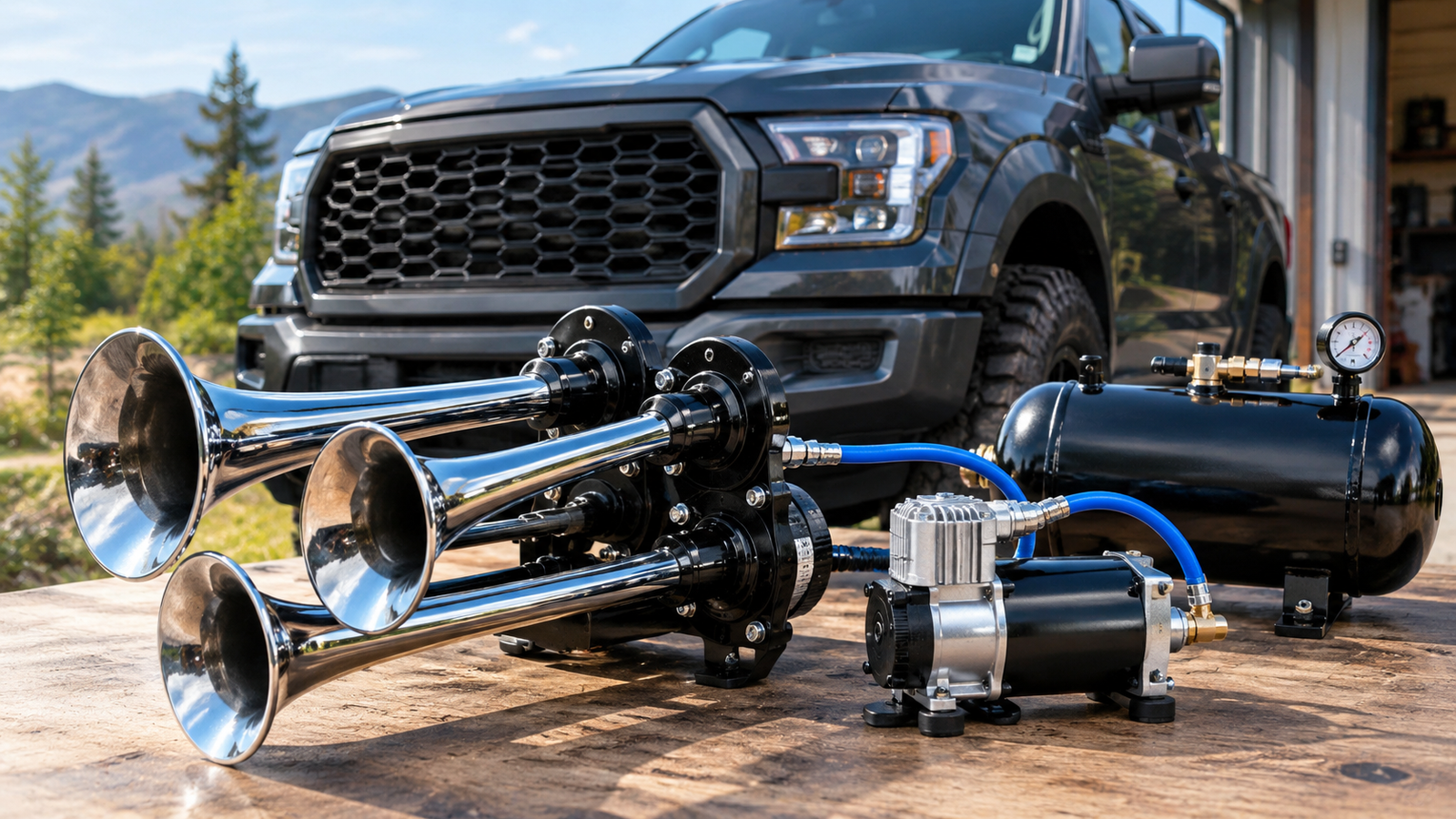
A vehicle air horn system has a horn or several trumpets, a compressor, a tank, a valve and wiring. Trucks and buses usually draw air from the same supply that powers their brakes. Cars and pickups have no such supply, so they need their own.
A stand alone horn is only the horn and its electric valve. If the vehicle has no onboard air, you also need a tank and compressor, and a complete kit is the easier route.
Marine Air Horns
Boats use horns for signaling in fog and in close quarters. They are built to handle spray and salt. Requirements for sound signals often depend on the size of the vessel and the waters you sail, so confirm the rules with your local maritime authority before you buy.
Train Horns Versus Air Horns
The two terms overlap, but they are not identical. One manufacturer explains that the difference is tone, not the number of trumpets: a train horn is tuned to a deep chord like a locomotive, while an air horn gives a sharper, higher blast. Both run on the same kind of air system, so the choice comes down to the sound you want.
Where You Will Hear One
Air horns have a surprising cultural life. The hockey goal horn is said to have started in 1973, when the Chicago Blackhawks owner liked the sound of a yacht horn and had one installed in his arena. Today, goal horns and end of round horns are part of the atmosphere at many sports venues.
On the rails, the sound follows a pattern. In the United States, locomotives must sound a standard sequence of two long, one short and one long blast before a level crossing. Knowing that pattern helps you recognize what you are hearing next time you wait at a crossing.
How Loud Is an Air Horn?
Loud, and louder than most people expect. The numbers vary a lot between products, so it helps to understand what they mean.
Understanding Decibels
Decibels are measured on a logarithmic scale. Every 3 dB roughly doubles the sound energy, and every 10 dB sounds about twice as loud to the human ear. So a 130 dB horn is not slightly louder than a 120 dB one. It is a big step up.
For context, typical car horns measure roughly 107 to 109 dB. One manufacturer’s guide says air horns generally fall between about 110 and 145.8 dB. A public health source puts an air horn at about 129 dB, which it describes as enough to cause immediate harm to the ears.
Why Advertised Numbers Can Mislead
A decibel rating means little unless you know how it was measured. The same manufacturer’s guide stresses that decibel figures only mean something when the method of measurement is known.
Distance is the biggest factor. In open air, sound drops by about 6 dB each time you double the distance. A horn rated at 120 dB from one meter measures about 114 dB from two meters and about 108 dB from four meters. A number taken from a few inches away can look far more impressive than what a listener actually hears.
When you compare products, look for three things:
- A stated measurement distance
- Independent testing rather than a claim alone
- Realistic figures, since extreme numbers with no explanation deserve doubt
Air Horn Safety and Your Hearing
Hearing damage is cumulative and permanent. Over time, any sound at 85 decibels or higher can cause hearing loss or problems such as tinnitus. An air horn goes far past that line.
A rough calculation shows how quickly the safe window closes. The 85 dB threshold comes with a rule that safe exposure time halves for every 3 dB increase. Starting from an eight hour allowance at 85 dB, you reach 130 dB after fifteen halvings, which leaves less than one second. This is a rough model for steady noise, not a prediction for a single blast, but it shows why close range use is a real risk.
Practical habits keep everyone safe:
- Never sound an air horn near a person’s head, and never as a prank.
- Wear earplugs or ear defenders if you are close to one at an event.
- Give pets and children extra distance, since they cannot judge the risk.
- Test a new horn outdoors, pointed away from people, and start with a short burst.
Are Air Horns Legal?
There is no single global answer. Rules depend on where you are and how you use the horn, and this is general information rather than legal advice.
In the United States, most states require a vehicle horn to be audible from a set distance, commonly 200 feet, while banning a horn that produces an unreasonably loud or harsh sound. The federal traffic safety agency leaves most horn regulation to the states. Some places also restrict horns that imitate emergency or railway signals.
Public use raises a separate issue. Sounding a horn in a residential area or to startle someone can lead to noise complaints and even fines. Before mounting a horn on a vehicle, check your local vehicle code and noise ordinances, and consider keeping an ordinary horn as your everyday signal.
How to Choose the Right Air Horn
Start with the job, not the decibel number. A horn that suits a truck is wrong for a hiking pack.
- Events and sports: A portable air horn, either canned or rechargeable, works well. Choose based on how often you will use it, and plan hearing protection for people nearby.
- Hiking and camping: Pick something compact and light that you can reach quickly. Its main jobs are signaling for help and startling wildlife at a distance.
- Boating: Buy a marine rated horn and confirm what your vessel requires.
- Cars, trucks and RVs: An air horn kit with a compressor and tank is the practical choice. Check legality first.
- Just the sound: If you only want the effect for videos or fun, a sound app or audio clip has no hearing risk at all.
Then run through a short checklist:
- Look for a stated measurement distance and independent test results.
- Match the power source to how you will use it: can, battery, or vehicle air.
- Check the size, weight and mounting options.
- Confirm voltage and valve ratings for vehicle systems.
- Read the warranty and support terms.
Vehicle Installation Basics
Fitting an air horn system is not difficult, but a few details decide whether it sounds good.
Pressure. Most vehicle horns run on systems between 90 and 150 PSI, and around 150 PSI gives peak volume on most horns. More is not better. Pushing pressure past the sweet spot raises the pitch and thins the tone.
Air volume. The tank matters as much as the pressure. A starved tank cuts a blast short no matter how high the pressure is. If you want long, full blasts, size the tank accordingly.
Voltage. The horn itself runs on air, so only the valve is electrical, and valve ratings vary between 12V and 24V. Check the specification before you buy, especially for commercial trucks.
Mounting. Pick a solid spot with room for the trumpet, away from exhaust heat and moving parts. Longer horns give deeper notes, so measure your straight run before ordering. Follow the wiring diagram, use a proper fuse, and hire a professional if electrical work is not your strength.
Care and Troubleshooting
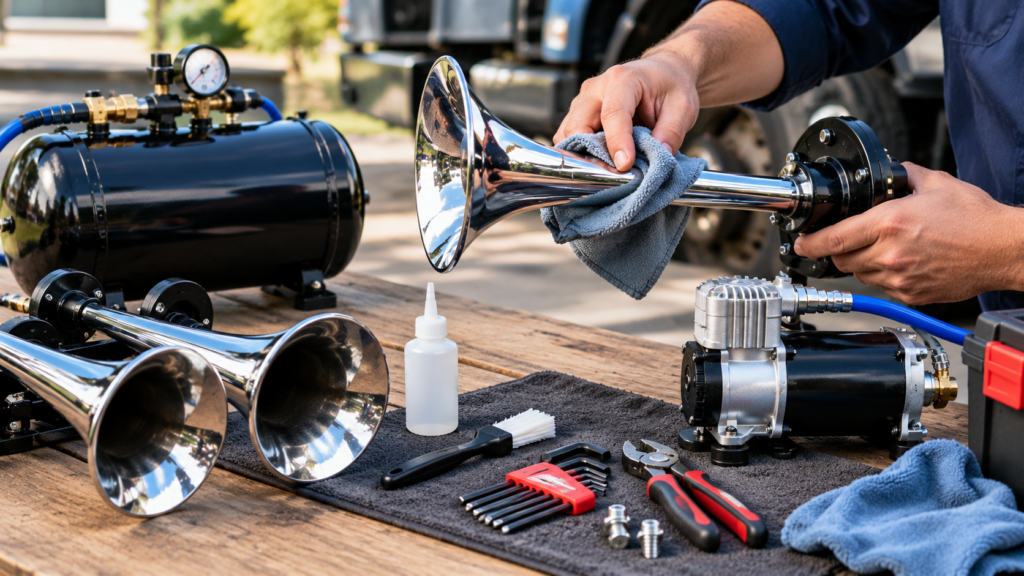
A little upkeep keeps an air horn reliable.
For canned horns, store them at moderate temperatures, away from heat and direct sun, and replace a can that sounds weak or sputters. For kit systems, drain moisture from the tank regularly, check fittings for leaks, and keep the mounting hardware tight.
If a vehicle horn sounds weak, low air pressure is the usual suspect. Look for leaks, a struggling compressor, or a valve that is not opening fully. If it makes no sound at all, check the fuse, the relay and the wiring before assuming the horn has failed.
Conclusion
An air horn is a straightforward tool: compressed air, a vibrating diaphragm, and a trumpet that shapes the sound. What makes one right for you depends on your use, and volume is only one part of that.
Remember the essentials. Longer horns sound deeper and carry farther. Decibel claims need a measurement distance to mean anything. Any air horn is loud enough to threaten hearing at close range. Local rules matter, especially for vehicle installations.
Choose the horn that fits the job, test it safely, and keep it pointed away from people. Do that, and an air horn will do exactly what you want it to: get attention when it counts.
FAQ
How loud is an air horn?
It depends on the model. Typical figures run from about 110 dB to well over 140 dB, and a public health source cites around 129 dB. Always check how far away the measurement was taken.
Can an air horn damage your hearing?
Yes. At close range, an air horn is loud enough to cause immediate harm, and repeated exposure adds up. Use hearing protection and never sound one near someone’s ears.
Is an air horn the same as a train horn?
They work the same way, but the tone differs. A train horn plays a deep chord tuned like a locomotive, while an air horn usually sounds sharper and higher.
Do I need a compressor for a vehicle air horn?
Only if the vehicle has no onboard air. Cars and pickups usually need a compressor and a tank, and a complete kit is the easiest way to get both.
Is it legal to use an air horn in public?
It depends on local law. Many places limit unreasonably loud vehicle horns, and sounding one to startle people can lead to fines. Check your local rules first.