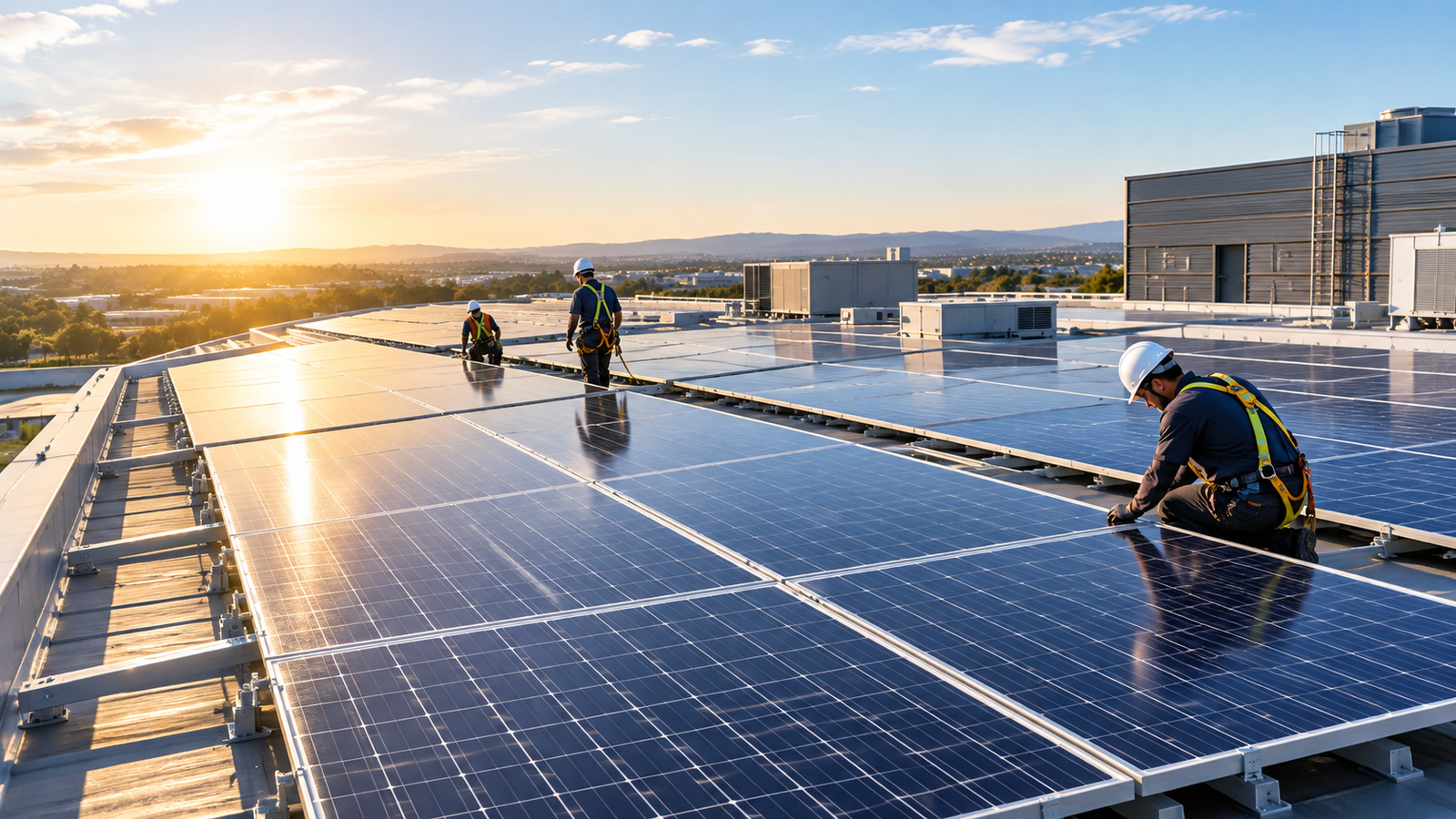
If you own or manage a commercial property, you have probably noticed your electricity bill climbing year after year with no sign of slowing down. Commercial solar panels have become one of the most reliable ways for businesses to take control of that expense, and the financial case for going solar has never been stronger.
This guide walks through everything a business owner actually needs to know before installing commercial solar panels: real cost figures, how the return on investment works, the tax incentives that make the math favorable, and how to choose both the right equipment and the right installer. Rather than repeating the same generic overview found on most solar company websites, this article focuses on the practical details that help you make a confident, informed decision.
What Are Commercial Solar Panels
Commercial solar panels are photovoltaic modules designed and sized for businesses, industrial buildings, warehouses, schools, and other large properties. They serve the same basic purpose as residential panels, converting sunlight into usable electricity, but they are built and installed differently to handle much larger energy demands.
How They Differ From Residential Panels
Commercial panels tend to be physically larger, often measuring around 45 by 90 inches compared to roughly 45 by 70 inches for residential panels. This larger surface area allows each panel to generate more power, which matters when you are trying to offset the energy use of an entire office building or manufacturing facility.
Commercial systems are also engineered around different priorities. Residential installations often emphasize aesthetics, since homeowners care how panels look on their roof. Commercial buyers, on the other hand, tend to prioritize cost per watt, output per square foot, and long term reliability, since the panels are typically not visible from the street.
Warranty structures differ too. Residential panels often carry longer product warranties, sometimes up to 30 years, while commercial panel warranties commonly run 12 to 25 years. Both types usually share a similar 25 to 30 year performance warranty guaranteeing a certain level of energy output over time.
How Commercial Solar Systems Work
A commercial solar system operates on the same core principle as any solar setup, just at a larger scale. Sunlight hits the panels and knocks electrons loose within the solar cells, generating direct current (DC) electricity.
That DC electricity then flows through inverters, which convert it into alternating current (AC), the type of power your building’s electrical system and equipment actually use. From there, the electricity either powers your operations directly or gets sent back to the grid if your system produces more than you need at that moment.
Most commercial installations connect to the local utility grid, which allows businesses to take advantage of net metering. Instead of storing every bit of surplus energy on site, you send it to the grid and receive bill credits, drawing that power back later when your panels are not producing enough, such as at night or on cloudy days.
Some businesses also pair their system with battery storage, particularly if they face high demand charges or need backup power during outages. This is not required, but it is worth discussing with your installer if energy reliability is a priority for your operations.
How Much Do Commercial Solar Panels Cost
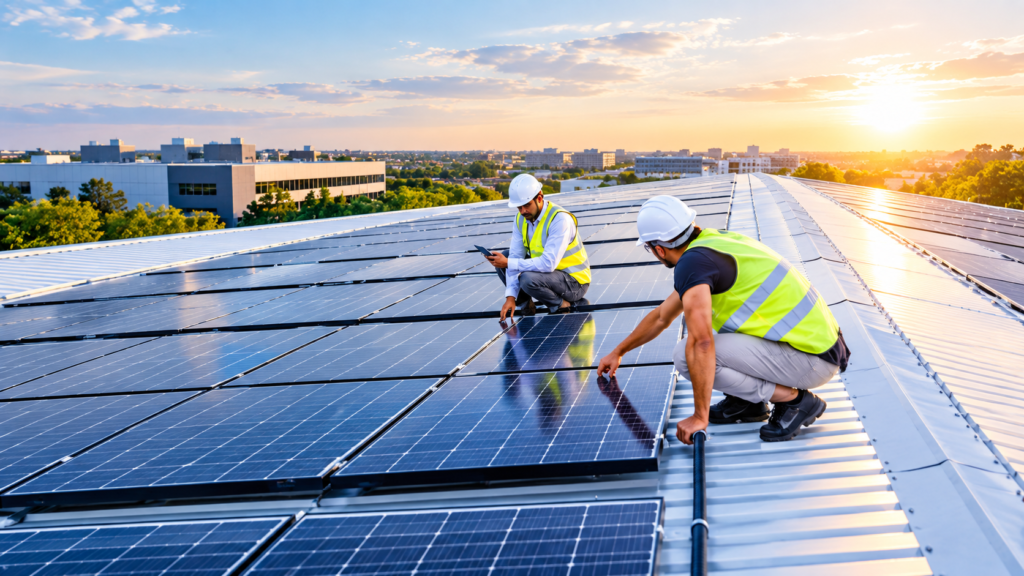
Cost is usually the first question on every business owner’s mind, and understandably so. According to recent industry data, the average cost for commercial solar installation sits around 1.10 to 1.50 dollars per watt before incentives, though this figure shifts based on system size, equipment quality, and site conditions.
Here is a general breakdown by project scale, which gives a more useful picture than a single average number:
| System Size | Typical Use Case | Estimated Cost Range |
|---|---|---|
| 1 to 5 kW | Parking meters, exterior lighting | 1,500 to 7,500 dollars |
| 50 to 100 kW | Small offices, schools | 60,000 to 150,000 dollars |
| 100 to 250 kW | Mid sized commercial buildings | 150,000 to 375,000 dollars |
| 250 to 500 kW | Warehouses, hospitals, factories | 375,000 to 750,000 dollars |
| 500 kW and above | Industrial parks, large campuses | 750,000 dollars and up |
What Affects the Price
Several variables push commercial solar costs up or down, and understanding them helps you avoid surprises during the quoting process.
- System size. Larger systems cost more overall but usually achieve a lower price per watt, since design and permitting costs get spread across more panels.
- Installation type. Roof mounted systems are typically the most affordable option. Ground mount and carport installations require more materials and structural work, which raises the price.
- Roof condition and type. An older roof may need reinforcement or replacement before installation, adding to the project cost.
- Add ons. Battery storage, EV charging stations, and custom mounting solutions like solar carports all increase the total investment, though they can also increase long term value.
- Available incentives. Federal, state, and local incentives can significantly reduce your net cost, which is covered in detail in the next section.
Tax Incentives and Financial Benefits
This is where commercial solar becomes genuinely compelling from a financial standpoint. Businesses have access to incentive programs that residential customers simply do not, and stacking these benefits often shortens the payback period considerably.
The Investment Tax Credit
The federal Investment Tax Credit, commonly known as the ITC, allows eligible businesses to deduct a percentage of their solar system’s cost directly from their federal tax liability. This credit has historically been set at 30 percent for most commercial projects, though rates and eligibility rules can change, so it is worth confirming current details with a tax professional before finalizing your project.
Accelerated Depreciation (MACRS)
The Modified Accelerated Cost Recovery System, or MACRS, lets businesses depreciate the value of their solar system over just five years instead of the system’s full useful life. This front loads the tax benefit, reducing taxable income significantly during the years when your business is still recovering the upfront installation cost.
Net Metering
As mentioned earlier, net metering credits your business for any surplus electricity your system sends back to the grid. Depending on your utility company and state regulations, these credits can offset up to 100 percent of your electricity usage at certain times of the year, effectively lowering your average cost of power even further.
Many states and municipalities also offer their own rebates, grants, or property tax exemptions for solar installations. These vary widely by location, so a local energy audit or consultation with a regional solar provider is the best way to identify every program your business qualifies for.
Calculating Your ROI and Payback Period
Numbers make this much easier to understand than percentages alone, so here is a simplified example using a mid sized commercial system.
Imagine a business installs a 150 kW rooftop solar system at a cost of 1.30 dollars per watt, bringing the total project cost to 195,000 dollars.
- After applying a 30 percent federal ITC, the net cost drops to approximately 136,500 dollars.
- MACRS depreciation over five years further reduces the effective cost by lowering the business’s taxable income, often by tens of thousands of dollars depending on the company’s tax bracket.
- With average annual electricity savings of around 25,000 to 30,000 dollars from reduced grid usage and net metering credits, many businesses recover their net investment within five to seven years.
- Since panels typically perform reliably for 25 years or more, that leaves roughly 18 to 20 years of substantially reduced or even near free electricity after payback.
Every business’s numbers will look different depending on local electricity rates, sun exposure, system efficiency, and financing method, but this example illustrates why so many commercial property owners describe solar as one of the more predictable investments available to them today.
Buying vs Leasing vs Power Purchase Agreements
Not every business wants to purchase a system outright, and there are legitimate reasons to consider alternative financing structures.
Direct purchase gives your business full ownership of the system, access to every available tax incentive, and the highest long term savings. This requires the largest upfront investment but delivers the strongest overall return.
Solar leases allow a business to install panels with little to no upfront cost while paying a fixed monthly fee to the leasing company. Maintenance is often included, but the business does not receive tax credits or the full value of energy savings, since those typically belong to the system’s owner.
Power Purchase Agreements, or PPAs, work similarly to leasing but instead of paying a flat fee, the business pays for the electricity the system produces at a rate that is usually lower than the utility’s standard price. This is attractive for businesses that want savings without any capital outlay, though total long term savings are generally lower than ownership.
A simple way to decide: if your business has available capital and wants to maximize savings and tax benefits, purchasing makes the most sense. If cash flow flexibility matters more than maximizing returns, a lease or PPA may be the better fit.
Choosing the Right Commercial Solar Panels
Not all commercial solar panels are created equal, and the specifications you choose will influence performance for decades. Here are the factors that matter most.
Monofacial vs Bifacial Panels
Monofacial panels generate electricity from a single side and work well for most standard rooftop installations. Bifacial panels capture sunlight on both the front and back, making them a strong choice for ground mounted systems or installations above reflective surfaces, since they can produce noticeably more energy in the right conditions.
Wattage and Efficiency
Commercial panels commonly range from around 400 watts to over 600 watts per panel, with higher wattage generally meaning more electricity generated per square foot of roof or ground space. For businesses with limited installation area, higher efficiency panels are often worth the added cost.
Warranty Coverage
Look closely at both the product warranty, which covers manufacturing defects, and the performance warranty, which guarantees a minimum level of energy output over time. Reputable manufacturers typically offer 12 to 25 year product warranties alongside 25 to 30 year performance guarantees.
How to Choose a Commercial Solar Installer
The equipment matters, but the installer you choose has just as much influence on your system’s long term performance. Use this checklist when evaluating potential contractors.
- Confirm they are licensed, bonded, and insured for commercial electrical work in your state.
- Ask for references from businesses with systems of a similar size to yours, not just residential customers.
- Request a detailed proposal that includes equipment brands, warranty terms, and projected energy production, not just a price quote.
- Ask how they handle permitting and utility interconnection, since delays here are one of the most common causes of project slowdowns.
- Find out what happens if a panel or inverter fails after installation. A reliable installer should offer clear maintenance support, not just a one time install and walk away.
Taking the time to vet installers properly often prevents costly issues down the road, including underperforming systems or warranty disputes.
Maintenance, Lifespan, and Risks to Understand
Commercial solar panels are built to be durable, but they are not entirely maintenance free, and understanding the realistic risks helps set proper expectations.
Panels themselves require very little upkeep beyond occasional cleaning, especially in dusty or high pollen areas, and periodic visual inspections to check for physical damage. Inverters typically need replacement once during the system’s lifetime, usually around the 10 to 15 year mark, since they tend to wear out faster than the panels.
Shading from nearby structures, trees, or rooftop equipment can meaningfully reduce output over time, so it is worth reassessing your site periodically, particularly if new construction goes up nearby. Roof condition also matters. If your roof is nearing the end of its life, it often makes sense to replace it before installing panels rather than removing and reinstalling the entire array a few years later.
With reasonable care, most commercial systems perform reliably for 25 years or longer, often continuing to generate meaningful electricity well past their official performance warranty period.
Is Commercial Solar Worth It for Your Business
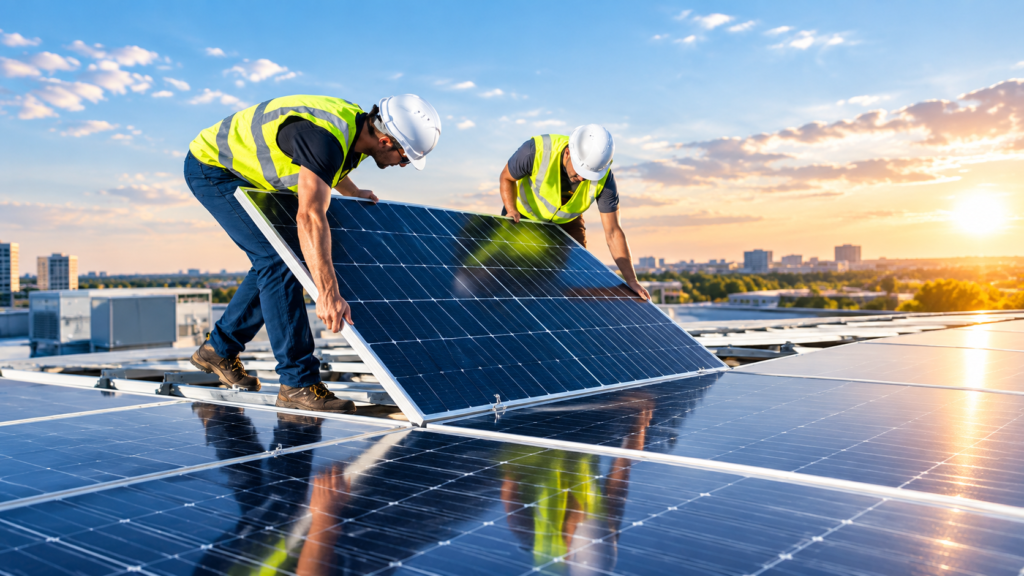
For most businesses, the answer leans strongly toward yes, though the right decision depends on a few specific factors. Businesses with high electricity usage, ample roof or ground space, and access to strong local incentives tend to see the fastest returns.
Companies in areas with high electricity rates or significant sun exposure generally benefit even more, since both factors directly increase the value of every kilowatt hour a system produces. Even businesses with more modest energy needs often find that the combination of tax credits, depreciation benefits, and long term utility savings makes solar a financially sound decision over a 20 to 25 year horizon.
The best next step is requesting a site specific assessment from a reputable commercial solar installer. This gives you real numbers based on your building, your local utility rates, and your actual energy consumption rather than industry averages.
Conclusion
Commercial solar panels have moved well beyond being a niche sustainability choice and have become a genuinely smart financial decision for many businesses. Between falling equipment costs, generous federal incentives like the ITC and MACRS depreciation, and the long term stability of predictable energy costs, the case for going solar is stronger than it has been in years.
The key takeaways are straightforward. Understand your system size needs and realistic cost range, factor in every available incentive before judging affordability, and choose both your equipment and your installer carefully, since both decisions affect performance for decades. Whether you decide to purchase outright or explore a lease or PPA, commercial solar panels offer a rare combination of environmental benefit and measurable financial return, making them well worth serious consideration for almost any business with adequate space and sun exposure.
Frequently Asked Questions
How long do commercial solar panels last?
Most commercial solar panels are built to last 25 to 30 years, with many continuing to produce meaningful electricity beyond their official performance warranty period.
Do commercial solar panels increase property value?
In many cases yes, since buyers and tenants increasingly value lower operating costs and sustainability features, though some regions also offer property tax exemptions specifically for solar installations.
What size commercial solar system does my business need?
System size depends on your average monthly electricity usage, available roof or ground space, and budget. A site assessment from a solar installer will give you an accurate recommendation based on your actual energy consumption.
Can a business get commercial solar panels with no upfront cost?
Yes, through a solar lease or a power purchase agreement, which allow businesses to install panels with minimal or no initial investment in exchange for monthly payments or reduced tax benefits.
Are commercial solar panels different from residential panels?
Yes, commercial panels are typically larger, prioritize output and cost efficiency over aesthetics, and are engineered to handle the higher energy demands of business operations.