Last spring, a friend of mine opened a closet and found her old guitar case under a pile of winter coats. She had not touched it in three years, not since her second child was born. She laughed, then she went quiet, because the guitar was not just an instrument. It was the last thing that had been only hers. If you are a busy parent, you probably know that feeling. The days are full, the calendar belongs to everyone else, and the things you once loved quietly slide to the bottom of the list. Learning how to make time for hobbies as a busy parent is not about finding extra hours. There are no extra hours. It is about taking small pieces of the time you already have and spending them on something that makes you feel like yourself again.
This guide is built around one simple idea. You do not need a free evening, a spare room, or a perfect schedule. You need a hobby that fits into 15 minutes, a place for it in your week, and permission from yourself to enjoy it without guilt. The seven methods below come from parents who made it work, and from research on what actually keeps a habit alive when life is chaotic. Try one method this week. If it sticks, add another.
Why hobbies disappear when kids arrive
Most parents do not quit their hobbies in one dramatic moment. The hobby fades in small steps. First the weekly class becomes a monthly class. Then the paints stay in the box because setting up takes longer than the free time available. Then a year passes and the hobby feels like something another person used to do. This is normal, and it is not a failure of willpower. It is a math problem. A parent of young children can lose four or five hours a day to care, cooking, cleaning, and work, and the hours that remain are usually broken into short scraps.
The cost of losing that time is real. A large study from University College London found that people who take part in arts and crafts report higher life satisfaction and a stronger sense of purpose than people who do not. Other research links regular hobbies with lower stress and better mood. None of this means a hobby will fix exhaustion or solve every hard day. It means that fifteen minutes with a sketchbook or a garden bed can change the shape of an evening, and that change adds up across a month.
Guilt is the other reason hobbies vanish. Many parents feel that any minute spent on themselves is a minute stolen from their children. That feeling is understandable, but it is backwards. A parent who never rests becomes shorter tempered, less patient, and less present. A parent who keeps one small pleasure alive often has more patience, not less. Your children do not need a parent who has given up everything. They need a parent who is steady, rested enough to listen, and still visibly a person with interests of their own.
How to make time for hobbies as a busy parent
The methods below work best in combination, but each one stands on its own. Pick the one that feels easiest and start there. The goal for the first week is not perfection. The goal is proof that hobby time can exist in your real life, with your real schedule, and your real children.
1. Shrink the hobby until it fits in 15 minutes
The biggest mistake busy parents make is keeping the hobby at its old size. If guitar used to mean an hour of practice, an hour now feels impossible, so the guitar stays in the case. Shrink the hobby until it fits the time you actually have. Fifteen minutes of guitar is still guitar. Ten minutes of sketching is still drawing. Five minutes of weeding is still gardening. The hobby does not need to look impressive. It needs to happen.
Start by defining the smallest useful version of your hobby. A reader can read ten pages. A cook can try one new recipe a week. A knitter can finish two rows. A photographer can take five pictures on a walk. Write that small version down and treat it as the whole hobby for now. You can grow it later. What matters is that the small version is so easy you can do it on a tired Tuesday, because tired Tuesdays are most of your life right now.

Keep a simple record of these small sessions. A tick on a calendar, a note in your phone, or a row of finished pages in a notebook all work. After two weeks, look at the record. Most parents are surprised. Fifteen minutes, four times a week, adds up to an hour of something they love, and that hour is often the best hour of the week. If you want a hobby that grows easily from small sessions, reading is a strong choice, and our guide on how to build a reading habit that sticks shows how to make ten pages a day automatic.
2. Put it on the calendar like a real appointment
Hobby time that lives only in your head will always lose to laundry, email, and school forms. Hobby time that lives on the calendar has a fighting chance. Pick two or three slots in the coming week, write them down, and treat them the way you would treat a dentist appointment. You would not cancel a dentist appointment because the kitchen needed tidying. Give your hobby the same respect.
Choose slots that already exist in your routine rather than inventing new ones. The half hour after the kids go to bed, the early morning before the house wakes, the lunch break on a work from home day, and the quiet stretch of a Sunday afternoon are all common choices. Tell your partner or a family member that the slot is yours. Saying it out loud makes it real, and it gives the other adults in the house a chance to protect it with you.
If a slot gets eaten by a sick child or a late meeting, do not throw the week away. Move the slot, shrink it, or take five minutes instead. A missed session is not a failed week. The parents who keep hobbies long term are not the ones who never miss a session. They are the ones who return after a miss without drama.
3. Find the pockets you already own
Most parents have more free time than they think, but it arrives in fragments. Ten minutes while dinner cooks. Twenty minutes in a waiting room. Half an hour on a train. The problem is that these fragments usually get filled by default with phone scrolling. One honest look at your screen time report will show you where the pockets are. Many parents find 45 minutes or more a day going to feeds they do not even enjoy.
You do not need to give up your phone. You need to move one pocket a day from scrolling to your hobby. Keep the hobby where the phone usually is. A book on the kitchen counter instead of the phone. A sketchbook by the sofa. A podcast about your hobby for the school run. When the pocket opens, the hobby is already within reach, and the choice becomes easy. If phone scrolling is the main thing eating your pockets, our guide on how to stop doomscrolling before bed without deleting apps offers gentle ways to take that time back.
4. Trade hours with your partner
If you parent with a partner, the fairest system is a trade. You take the kids for two hours on Saturday morning so your partner can do their thing. They take the kids for two hours on Sunday afternoon so you can do yours. No one has to ask permission each time, and no one has to feel guilty, because the trade is equal and it is already agreed.
Single parents can build a version of this too. Swap an hour with a friend, a grandparent, or another parent at the school gate. One parent watches both sets of children for an hour while the other goes for a run or a class, then you switch. These swaps work best when they are regular, even if they are short. An hour every week beats a whole free day that never comes.
Talk about the trade plainly. Many couples never discuss hobby time, so one person quietly gives it up and slowly grows resentful. A short honest conversation can fix years of silent frustration. Frame it as a practical arrangement, not a complaint. We both need one protected pocket a week. Here is how we make that happen.
5. Make starting stupidly easy
Every hobby has a setup cost, and setup cost is what kills busy parent hobbies. If painting means finding the box, laying newspaper, filling a jar, and cleaning brushes, you will not paint on a tired evening. Reduce the setup to almost nothing. Keep a small kit ready to go: a sketchbook and two pencils in a drawer, a guitar on a stand instead of in a case, a seed tray on a windowsill, a novel on your pillow.
The rule is simple. If starting takes more than two minutes, make it simpler. Buy a cheap sketchbook you are not afraid to spoil. Keep one pan and one recipe card for weeknight cooking experiments. Charge the camera the night before a walk. The easier the start, the more often you will start, and starting is the whole battle.

6. Let the kids join in sometimes
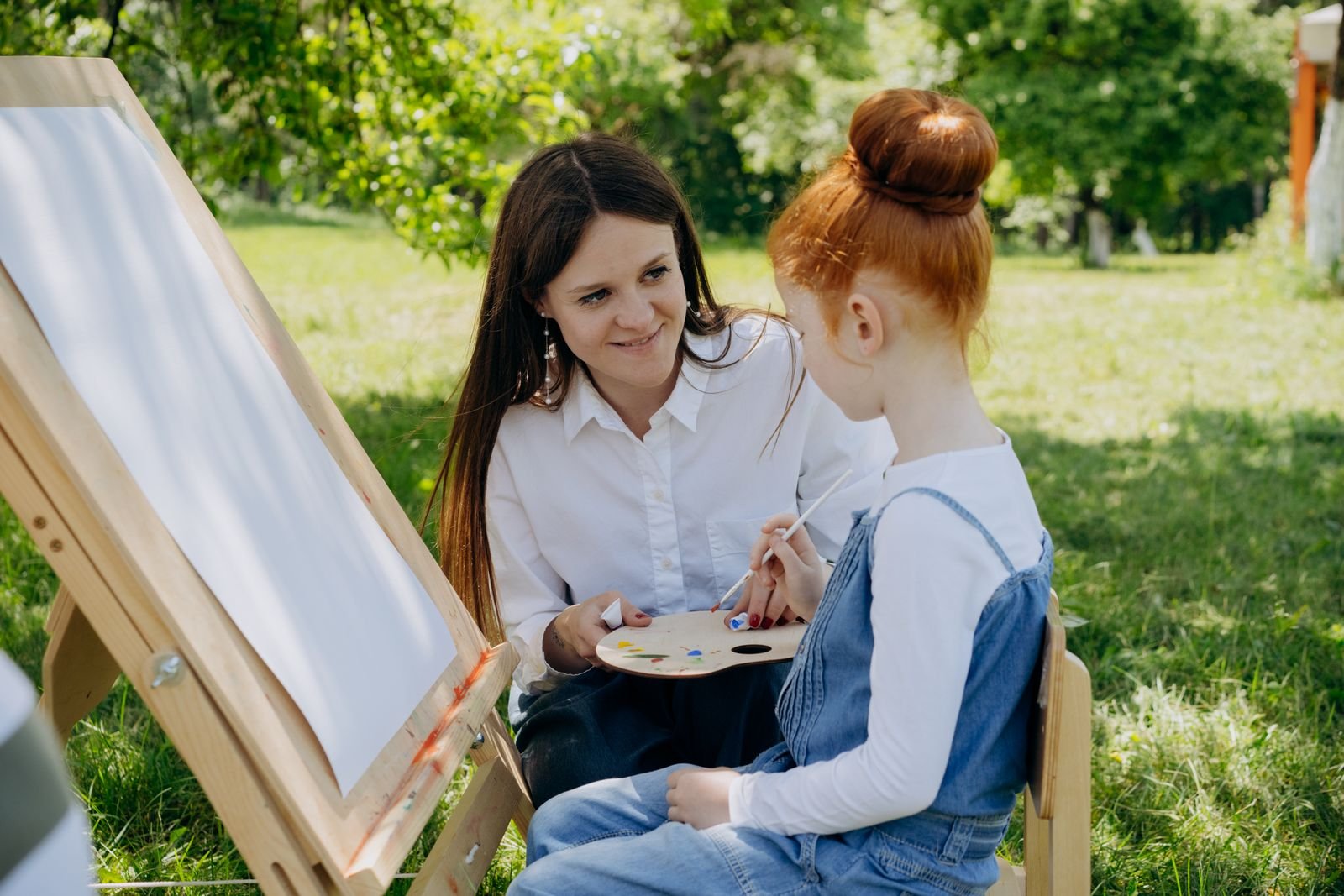
Not every hobby session needs to be solo. Some hobbies get better with small hands involved. Cooking, gardening, painting, music, and simple crafts all work as shared activities, and they teach your children something valuable: that adults keep learning and making things for joy, not just for work. A Saturday morning spent planting seeds together is hobby time and family time at the same time, and that double value makes it much easier to protect.
Keep shared sessions separate from solo sessions in your mind. Shared time is wonderful, but it is not the same as time alone with your hobby. Aim for a mix. Perhaps one shared session and one solo session each week. The solo session is where you go deeper and recharge. The shared session is where the hobby becomes part of family life instead of something that competes with it. If cooking together appeals to you, start with one simple recipe the kids can help with, like homemade pizza or a big salad they can assemble themselves.

7. Guard one evening a week
If the ideas above feel like too much to manage, start with just this one. Choose one evening a week and declare it yours. It does not need to be a whole evening. Ninety minutes is enough. During that window, you do your hobby, and the rest of the household handles itself. Put the evening in the family calendar, tell everyone about it, and defend it gently but firmly for a month.
One protected evening does two things. First, it guarantees a minimum amount of hobby time no matter how chaotic the week becomes. Second, it changes how you think about yourself. You stop being a person who used to paint and become a person who paints on Thursdays. That identity shift matters more than the hours. People protect the things that are part of who they are.
Pick a hobby that fits your real life
Some hobbies suit busy parents better than others, and the difference is usually setup time and flexibility. A good busy parent hobby can be started in two minutes, stopped in the middle without damage, and picked up again days later without losing your place. Reading, sketching, journaling, knitting, gardening in pots, cooking one new recipe a week, photography on a phone, and learning an instrument in short sessions all pass this test.
Hobbies that demand long uninterrupted blocks, expensive equipment, or travel to a venue are harder to keep alive right now. That does not mean giving them up forever. It means parking them for a season and choosing a smaller cousin instead. A parent who loved team sports might take up running or a home workout. A parent who loved long woodworking projects might try whittling or small repairs. The point is to keep the thread of the interest alive so it is easy to return to later.
If you have no idea what hobby to choose, start with what you already notice. What do you stop to look at? What do you save or share online? What did you love before children arrived? Try one hobby for two weeks before judging it. Two weeks is long enough to feel the pleasure of it and short enough that you have lost nothing if it is not the right fit. And if you are trying to cut back on screen time to make room, a gentle reset can help. Our guide on how to do a digital detox weekend shows how a short break from feeds can reveal how much time is actually available.
What to do when the guilt shows up
Guilt will show up, usually in the first week. It sounds like this: the kids need you, the house is a mess, other parents manage without hobbies, you should be working. Expect it, and have an answer ready. The answer is not an argument. It is a fact. You are a better parent when you are not running on empty, and fifteen minutes of something you love is maintenance, not indulgence.
Watch for the guilt that hides behind productivity. Many parents feel fine spending an hour on extra work or extra cleaning, but guilty spending twenty minutes on a hobby. That is not a moral rule. It is a habit of thought. Work and chores will always expand to fill the time you give them. If you wait until everything is done before you allow yourself a hobby, you will wait forever, because a family home is never fully done.
It also helps to let your children see you enjoying your hobby. Children learn by watching. A child who sees a parent reading, painting, or gardening learns that adults have inner lives and that pleasure is a normal part of a good life. You are not taking something from your children when you protect hobby time. You are showing them how a grown up stays whole.
Your first week plan
Here is a simple plan for the next seven days. It takes about fifteen minutes a day and it is designed to be forgiving. If you miss a day, just pick up the next one.
- Day one: choose your hobby and write down its smallest version, the one that fits in fifteen minutes.
- Day two: set up your kit so starting takes less than two minutes, and put it where you will see it.
- Day three: take your first fifteen minute session, and tick it off on the calendar.
- Day four: find one pocket of time you usually spend scrolling, and spend it on your hobby instead.
- Day five: tell your partner or a friend about your hobby time, and agree one protected slot for next week.
- Day six: try a shared session with the kids if your hobby allows it, and notice how it feels.
- Day seven: look at your week, keep what worked, drop what did not, and plan next week in two minutes.
After that first week, you will know more about your own life than any article can tell you. You will know which pockets are real, which slots survive contact with family life, and whether your chosen hobby fits. Adjust from there. The plan is a starting point, not a contract.
Conclusion
Making time for hobbies as a busy parent is not about waiting for life to calm down. Life with children does not calm down on a schedule. It is about shrinking the hobby to fit the time you have, putting that time on the calendar, trading hours fairly, making the start easy, and letting go of the guilt that says your own pleasure does not count. Fifteen minutes, a few times a week, is enough to keep a hobby alive, and a hobby kept alive keeps a part of you alive too. Pick the smallest version of something you love, set up the kit tonight, and take fifteen minutes tomorrow. Your future self, the one who still paints, plays, reads, or grows things, will be glad you started now.
Frequently Asked Questions
How much time do I need for a hobby as a busy parent?
Fifteen minutes, three or four times a week, is enough to keep most hobbies alive and enjoyable. Short regular sessions beat rare long ones, because they build a habit and they fit real family schedules.
Is it selfish to spend time on a hobby when my kids need me?
No. Short breaks for something you enjoy help you return to parenting with more patience and energy. Children benefit from a parent who is steady and rested, and they learn by watching you keep an interest of your own.
What are the best hobbies for busy parents?
The best hobbies start in under two minutes and can be paused at any point. Reading, sketching, journaling, knitting, container gardening, cooking one new recipe a week, phone photography, and short music practice all work well for parents with little free time.
How do I stay consistent with a hobby?
Put fixed slots on the family calendar, keep your kit ready to use, and track each session with a simple tick. If you miss a session, return at the next slot without guilt. Consistency comes from easy restarts, not from never missing a day.
What if my partner does not support hobby time?
Talk about it as a fair trade rather than a favour. Offer your partner the same protected time for their own interest, agree the slots together, and start small with one evening a week. A clear equal arrangement is easier to support than an open ended request.