If you have typed calendario mundial 2026 into a search bar recently, you already know the feeling. There are dozens of pages, half of them outdated, and none of them seem to answer the one question you actually have: when does my team play, and what time is it where I live?
This guide brings everything together in one place. You will find the full calendario mundial 2026, explained clearly, along with the details that most schedule pages skip entirely, like how the new format works, why some matches list a team as still undecided, and how to plan your viewing around your own time zone instead of guessing.
Why This World Cup Schedule Is Different From Any Before It
The 2026 edition is the biggest FIFA World Cup in history, and that alone changes how the calendar works. Instead of 32 teams, this tournament features 48 national teams. Instead of 64 matches, there are 104.
That expansion means an extra knockout round was added between the group stage and the traditional Round of 16. Many fans searching for the calendario mundial 2026 are confused when they see a Round of 32 listed, simply because it did not exist in previous editions.
Another major shift is the host setup. For the first time, three countries share hosting duties: the United States, Mexico and Canada. That means stadiums, kickoff times and even the climate vary enormously from one match to the next, which makes an accurate calendar more useful than ever.
Calendario Mundial 2026: The Key Dates Every Fan Should Know
Understanding the full calendario mundial 2026 becomes much easier once you break it down stage by stage. Each phase of the tournament has its own rhythm, and knowing that rhythm helps you plan ahead instead of scrambling for information the night before a match.
Opening Match and Group Stage
The tournament kicks off on June 11 with the opening match, hosted at the Estadio Azteca in Mexico City. As the host nation, Mexico plays the very first game of the competition, a tradition that has become one of the most anticipated moments of any World Cup.
From there, the group stage unfolds across three matchdays:
- Matchday 1 runs from June 11 to June 17.
- Matchday 2 runs from June 18 to June 23.
- Matchday 3, the shortest window, runs from June 24 to June 27, with all matches in each group played simultaneously to keep things fair.
This structure alone accounts for 72 of the 104 total matches, so the majority of the action happens in this compact two week stretch.
Round of 32
Once the group stage wraps up, the new Round of 32 begins. This round runs from June 28 through July 3 and determines which 16 teams advance to the traditional knockout bracket.
For fans used to older tournaments, this is the biggest structural change in the calendario mundial 2026. It adds an extra week of matches and gives more teams a real shot at reaching the knockout stage.
Round of 16, Quarterfinals and Semifinals
The Round of 16 takes place from July 4 to July 7, followed by the quarterfinals on July 9, 10 and 11. The semifinals are held on July 14 and 15, setting up the final two weeks of the tournament as the intensity builds match by match.
Third Place Match and the Final
The third place playoff is scheduled for July 18, one day before the grand finale. The final itself takes place on Sunday, July 19, at MetLife Stadium in East Rutherford, New Jersey, closing out more than five weeks of football.
Host Countries, Cities and Stadiums
One detail that often gets lost in shorter schedule articles is just how spread out this World Cup really is. Matches take place across 16 host cities in three countries, and the distances involved are unlike anything in previous tournaments.
In Mexico, matches are held in Mexico City, Guadalajara and Monterrey. Canada hosts games in Toronto and Vancouver. The remaining cities are spread across the United States, including Los Angeles, San Francisco, Seattle, Houston, Kansas City, Atlanta, Miami, Dallas, Philadelphia, Boston, New York and New Jersey.
Why does this matter for the calendario mundial 2026 beyond curiosity? Because travel time, climate and stadium capacity all affect when matches are scheduled. A game in Vancouver at night will look very different in terms of local kickoff time compared to one played in the early afternoon in Mexico City, even on the same competition day.
Match Times by Region: How to Never Miss a Game
This is where most schedule pages fall short. They list kickoff times in a single time zone, usually the host country’s, and leave international fans to do the math themselves.
Here is a simplified way to think about it. Matches are generally played at three staggered daily windows to accommodate the tournament’s broadcast needs:
- Early matches, often scheduled around midday in Mexico and the U.S. Central time zone.
- Midday matches, timed for prime afternoon viewing across Latin America.
- Evening matches, scheduled for nighttime audiences in Europe.
For fans in Spain, add roughly seven to eight hours to Mexico City time depending on the specific match slot. For fans in Argentina, Uruguay and Chile, the difference from Mexico City time is typically two to three hours ahead. Colombia, Peru and Ecuador generally share the same time zone as Mexico City or sit one hour ahead.
Because the exact offset can shift slightly depending on daylight saving adjustments in each country, it is worth double checking the specific match you care about closer to the date, rather than relying on a fixed rule for the entire tournament.
How the Draw and Group Stage Pairings Actually Work
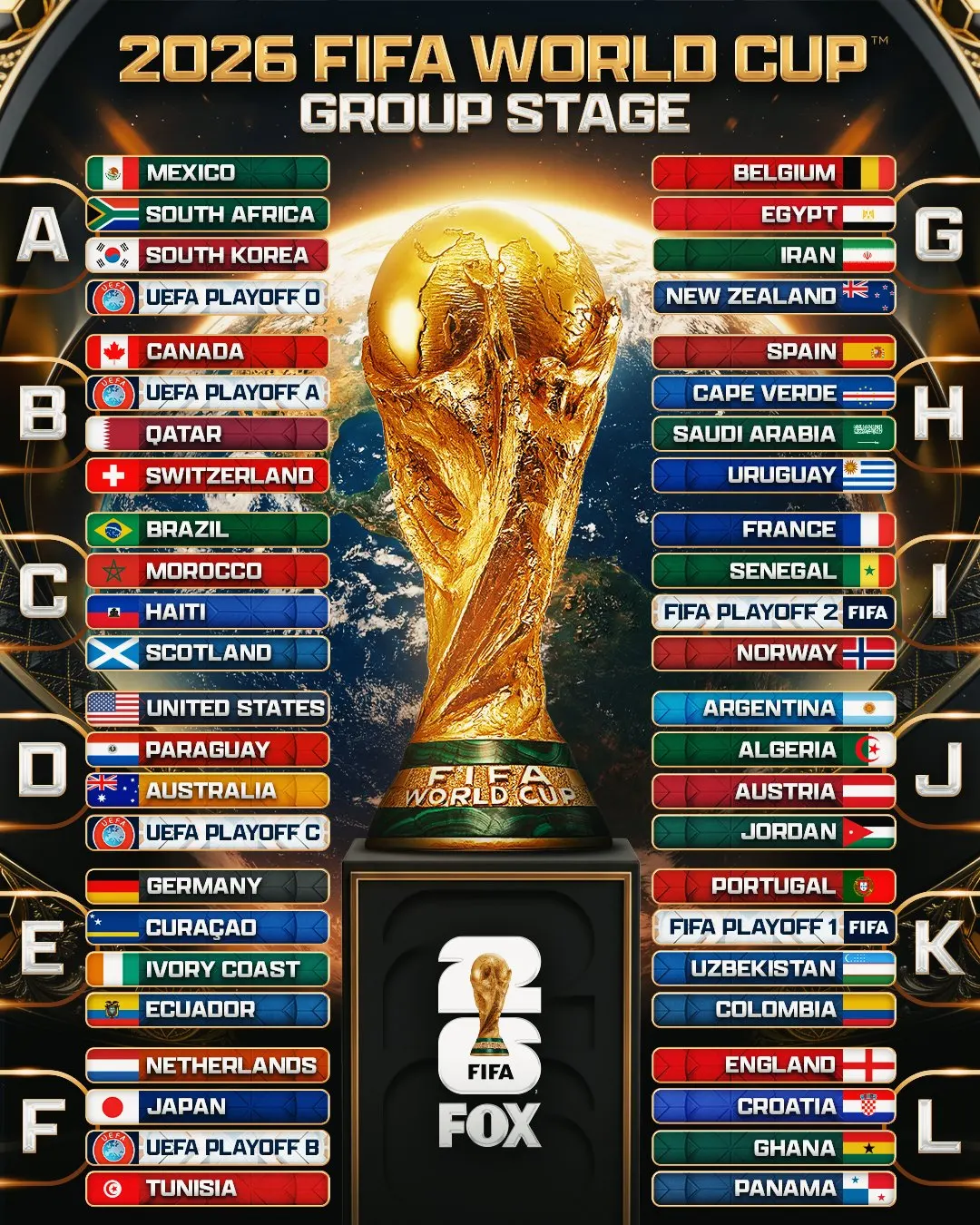
If you have looked at the calendario mundial 2026 and noticed team names like Winner UEFA Playoff, you are not looking at an error. Six spots in the tournament were still undecided at the time of the draw, pending the completion of European playoff matches in late March 2026.
FIFA structured the group stage pairings using a straightforward pattern. In matchday one, the strongest ranked team in each group faces the second strongest, while the third and fourth face off separately. Matchday two flips those pairings, and matchday three brings everyone together with simultaneous kickoffs.
This system is designed to keep the competition balanced and to prevent any team from having an unfair schedule advantage, something that has occasionally been criticized in past tournaments.
Where to Watch: TV and Streaming Options
Broadcast rights for the 2026 World Cup are split across multiple networks depending on your country. In the United States, coverage is shared between Fox, FS1 and Telemundo for Spanish language broadcasts, along with streaming through associated platforms.
TUDN, Canal 5 and Azteca Deportes hold major broadcast rights in Mexico, alongside their respective streaming apps. Spain and much of Latin America typically get coverage through regional sports networks and their digital platforms, so it is worth checking your local provider a few weeks before kickoff to confirm access.
Streaming has become the primary way many fans follow the calendario mundial 2026 in real time, particularly for viewers who are traveling or watching outside their home country. Confirming your access early avoids any last minute scrambling once the tournament begins.
Practical Tips for Planning Around the Tournament
A few small habits make following this World Cup significantly easier, especially given how packed the schedule becomes during the group stage.
- Add matches to your personal calendar app as soon as your team’s fixtures are confirmed, rather than relying on memory.
- Set time zone reminders a day in advance, since match windows shift depending on the stage of the tournament.
- Bookmark one reliable schedule source instead of checking multiple sites, since minor time discrepancies between outlets are common closer to matchday.
- If you plan to attend matches in person, research transportation between host cities early, since distances between some venues are substantial.
Common Mistakes Fans Make When Reading the Schedule
Even experienced fans run into a few recurring issues when trying to follow the calendario mundial 2026. Being aware of them in advance can save real confusion later.
One common mistake is assuming all matches on the same date kick off at the same time. In reality, most matchdays feature staggered kickoffs across the day to accommodate broadcast windows in different regions.
Another frequent error is confusing local stadium time with the viewer’s home time zone, particularly during the transition between matchday two and matchday three, when European daylight saving changes can shift the math slightly.
Finally, many fans overlook the fact that some teams in the schedule were placeholders until March 2026. Checking the calendar again once qualification concluded is essential to avoid confusion about who your team is actually facing.
Final Thoughts
The calendario mundial 2026 is more than a simple list of dates. With three host countries, 48 teams and an extra knockout round, this tournament asks a bit more from fans who want to follow it properly.
The good news is that once you understand the structure, from the group stage rhythm to the staggered kickoff times and the new Round of 32, the rest of the schedule becomes far easier to follow. Keep this guide handy as the tournament approaches, confirm your local kickoff times as matchday nears, and you will be ready for every single game, right up to the final whistle on July 19.
Frequently Asked Questions
When does the 2026 World Cup start?
The tournament begins on June 11, 2026, with the opening match at Estadio Azteca in Mexico City.
How many matches are in the 2026 World Cup?
There are 104 total matches, the most in tournament history, reflecting the expanded 48 team format.
Which countries are hosting the 2026 World Cup?
Mexico, the United States and Canada are co hosting the tournament across 16 cities.
When is the World Cup final?
The final takes place on Sunday, July 19, 2026, at MetLife Stadium in East Rutherford, New Jersey.
Why does the schedule show undecided teams in some matches?
Six qualification spots were determined through European playoffs that concluded in late March 2026, after the initial draw took place.